Gyrotonic vs. Pilates: Which One Is Right for Your Body?
Quick answer: Pilates builds strength and control by stabilizing your core through precise, mostly linear movements on spring-based equipment. Gyrotonic builds mobility and strength through continuous circular, spiraling movements on pulley-and-weight equipment, with the spine moving in three dimensions. Choose Pilates for core stability and posture. Choose Gyrotonic for fluid spinal mobility. Many bodies do best with both.
People ask us this all the time.
Usually right after they walk past our Gyrotonic tower and say, “Wait, what is that?”
We teach both methods at S2S, under the same roof as our physical therapy clinic, so we have no reason to push one over the other. Here’s the honest comparison.
What is Pilates?
Pilates is a low-impact exercise method that strengthens the deep core, improves posture, and trains precise, controlled movement.
Joseph Pilates created it during World War I, calling it “Contrology.” It began as a way to rehabilitate injured soldiers, then became a staple for dancers in New York.
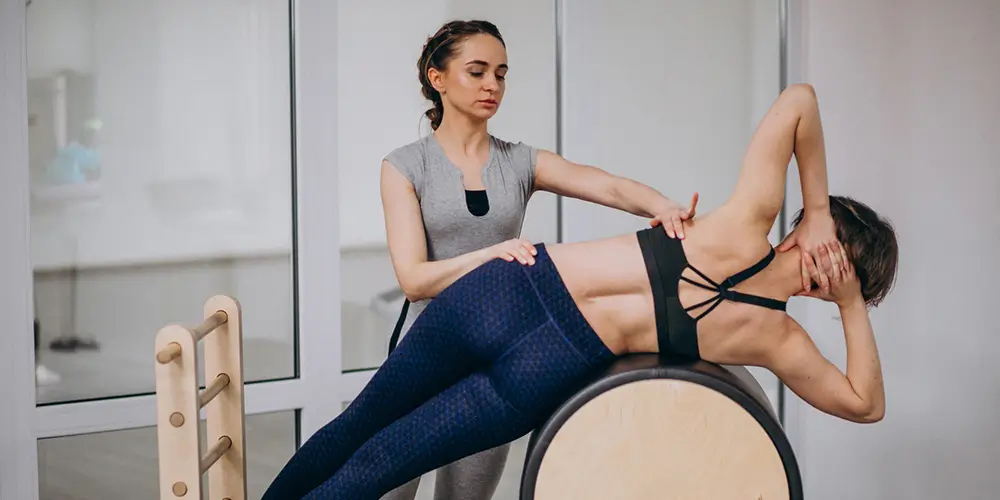
You can do Pilates on a mat or on equipment like the reformer, which uses springs for resistance and assistance.
What is Gyrotonic?
Gyrotonic is a movement method built on circular, spiraling, wave-like exercises that move the spine in every direction while building strength and joint mobility.
Juliu Horvath, a former professional dancer, developed the Gyrotonic Expansion System in the 1980s in New York after injuries ended his dance career. It has two parts:
- GYROTONIC®: done on specialized equipment, like the Pulley Tower Combination Unit, which uses pulleys and weights.
- GYROKINESIS®: done without equipment, on a mat and stool.
Horvath has been clear that his methods did not come from Pilates. People often describe Gyrotonic as combining elements of yoga, dance, swimming, and tai chi.
Gyrotonic vs. Pilates at a glance
| Pilates | Gyrotonic | |
|---|---|---|
| Created by | Joseph Pilates, WWI era | Juliu Horvath, 1980s |
| Movement style | Precise, mostly linear, controlled | Circular, spiraling, flowing |
| Core approach | Stabilize the core while limbs move | Core moves and spirals with the limbs |
| Equipment resistance | Springs (reformer, tower, chair) | Pulleys and weights (pulley tower) |
| Breathing | Coordinated breath to support control | Breath patterns matched to movement rhythm |
| Best known for | Core strength, posture, stability | Spinal mobility, joint range, fluid strength |
| Research base | Larger (including a Cochrane review) | Smaller, mostly limited studies |
| Format at S2S | Private, duo, and small group (max 6) | Private sessions (30 or 60 minutes) |
The real difference: stabilize vs. spiral
Here’s the simplest way we explain it.
Pilates teaches your core to hold steady so your arms and legs can move well. Think of a strong, quiet center.
Gyrotonic teaches your spine to move freely in every direction, with strength, so nothing gets stuck. Think of a wave moving through your whole body.
Neither is better. They train different qualities. And most people are missing one of the two.
Which is better for back pain?
It depends on what kind of back you have.
Pilates has the stronger research. A Cochrane review of 10 trials found low to moderate quality evidence that Pilates reduces pain and disability in chronic low back pain compared with minimal intervention. The same review found no proof it beats other types of exercise. (We cover more in Pilates for back pain.)
Gyrotonic research is much thinner. But clinically, its gentle, active-assisted range of motion often feels good for people whose backs are stiff and guarded rather than unstable.
Our rule of thumb:
- Back feels unstable, or pain comes with lifting and sudden movements? Start with Pilates.
- Back feels stiff, locked, and tight, especially rotating? Gyrotonic may feel like relief.
- Pain is new, severe, or runs down your leg? Start with a physical therapy evaluation before either one.
Who tends to love Pilates
- People rebuilding core strength after injury, pregnancy, or time off
- Desk workers fighting posture fatigue
- Runners and golfers who want a stable trunk
- Anyone who likes precision, clear cues, and measurable progress
Who tends to love Gyrotonic
- Dancers and performing artists
- Golfers, tennis players, and swimmers who rotate for their sport
- People who feel “tight everywhere” and want mobility with strength
- Active older adults who want joint-friendly movement
- Anyone bored by counting reps
Can you do both?
Yes. And it’s often the smartest option.
Pilates builds the stable base. Gyrotonic expands how far and how freely you can move on top of it. Many of our clients alternate: group Pilates classes during the week, plus a private Gyrotonic session.
Pro tip: If you’re new to both, start with Pilates to learn core control, then add Gyrotonic within a month. The body awareness carries over.
What your first session looks like at S2S
For Gyrotonic: We recommend starting with a private orientation. Sessions are offered in 30 minute and 1 hour private formats, one-on-one with an instructor on the Gyrotonic Pulley Tower Combination Unit.
For Pilates: Our instructors hold certifications through STOTT Pilates, Polestar Pilates, and Peak Pilates. A private orientation is recommended before group classes, and no S2S class has more than 6 people. Here’s how S2S Pilates is different from a typical studio.
Both are taught alongside our physical therapy team, which means your instructor can loop in a PT when something doesn’t feel right. That’s especially helpful after physical therapy ends.
Your “which one should I try first?” checklist
- Want a stronger core and better posture? Pilates.
- Feel stiff, rotate for your sport, or come from dance? Gyrotonic.
- Recovering from back pain that feels unstable? Pilates first.
- Bored of linear workouts and want flowing movement? Gyrotonic.
- Have new, sharp, or radiating pain? Physical therapy evaluation first.
- Can’t decide? Try both. Your body will tell you.
Frequently asked questions
Is Gyrotonic harder than Pilates?
Not harder, just different. Gyrotonic’s continuous circular movement feels unfamiliar at first, while Pilates asks for precise control. Most beginners find both challenging in the first few sessions.
Is Gyrotonic good for scoliosis or a stiff spine?
Gyrotonic’s three-dimensional spinal movement can help many people with stiffness, but scoliosis needs an individual plan. Get a physical therapy evaluation first so your instructor knows what to emphasize and avoid.
What’s the difference between Gyrotonic and Gyrokinesis?
Both belong to the Gyrotonic Expansion System. GYROTONIC uses specialized pulley-and-weight equipment, while GYROKINESIS uses a mat and stool with no equipment.
Does insurance cover Gyrotonic or Pilates?
No. At S2S, Gyrotonic and Pilates are fitness services, not physical therapy, so insurance doesn’t cover them. We offer packages and memberships instead.
Where can I do Gyrotonic near Dallas?
S2S Functional Performance offers private Gyrotonic sessions in Flower Mound and Frisco, taught alongside our Pilates and physical therapy teams.
Try it for yourself
Reading about movement only gets you so far.
Book a private session through Gyrotonic at S2S, explore S2S Pilates in Flower Mound or Frisco, check the class schedule, or start with the $89 Intro Experience: three group classes for the price of two. Ready to commit? See the S2S Membership.